
Folkwang
- Über Folkwang
- Aktuell
- Studium
- Organisation
- Personen
- Beratung & Hilfe
- Antidiskriminierung & Gleichstellung
- International
- Veranstaltungen
Michèle Anne De Mey und Thierry De Mey starten Pina Bausch Professur 2026|27 an Folkwang
Auftakt des Projektes FRAMES mit ausgewählten Folkwang Studierenden verschiedener Disziplinen
Englisch version below
Der Folkwang Universität der Künste ist es gelungen, die Tänzerin und Choreographin Michèle Anne De Mey und den Komponisten, Filmemacher und Künstler Thierry De Mey für die Pina Bausch Professur 2026|27 zu gewinnen. Die renommierten und interdisziplinär tätigen Künstler*innenpersönlichkeiten starten ihre gemeinsame Arbeit mit ihrem Living Lab FRAMES am Campus Essen-Werden der Folkwang Universität der Künste mit gut 20 internationalen Folkwang Studierenden.
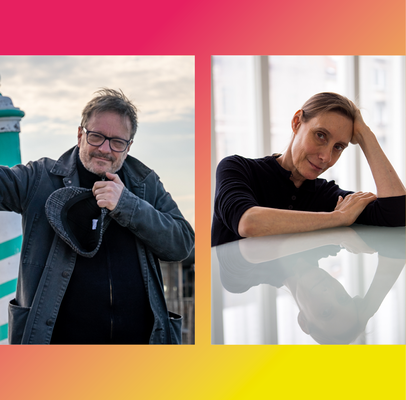
Fotos: Arturo De Mey; Gaspard Pauwels | Gestaltung: Luise Jakobi und Jana Ollech
Die beiden Künstler*innen stehen für ein genreübergreifendes und international viel beachtetes künstlerisches Schaffen in den Bereichen Choreographie, Musik und Film. Neben zahlreichen Kollaborationen unter anderem mit Choreographin Anne Teresa De Keersmaeker, Filmemacher Jaco Van Dormael, Regisseur Robert Wilson, Choreograph William Forsythe sowie mit Institutionen wie Charleroi Danses, dem choreographischen Zentrum der Föderation Wallonie-Brüssel, und dem Pariser Institut de recherche et coordination acoustique/musique (IRCAM) blicken sie auch als Geschwisterpaar auf eine erfolgreiche wie künstlerisch vielschichtige gemeinsame Zusammenarbeit zurück.
Nach ihrer Tätigkeit für das Folkwang Tanzstudio im Jahr 2005 sind Michèle Anne De Mey und Thierry De Mey mit dieser Gastprofessur nach über 20 Jahren nun erstmals wieder an der Folkwang Universität der Künste präsent.
Im Rahmen der Pina Bausch Professur 2026|27 starten sie die Arbeit mit gut 20 Folkwang Studierenden aus allen Studienbereichen am Folkwang Campus Essen-Werden. In der Verbindung von Choreographie, Musik, bildender Kunst und Performance wird dabei ein besonderer Fokus auf die Auseinandersetzung mit Grenzen, Perspektiven und zeitlichen Strukturen gelegt. Über eine interdisziplinäre künstlerische Praxis nähern sich die Teilnehmenden Fragen an wie: Was definiert einen Rahmen? Wie beeinflusst die Rahmung Bewegung, Wahrnehmung und Bedeutung? Was bleibt außerhalb des Rahmens? Wie entstehen Verbindungen?
Von September 2026 bis Juni 2027 wird es insgesamt drei intensive Workshop-Phasen mit allen Beteiligten geben. Als öffentlicher Höhepunkt und Abschluss ist für den 24. Juni 2027 eine Aufführung im Rahmen der Jubiläumsfeierlichkeiten der Folkwang Universität der Künste zu ihrem 100-jährigen Bestehen geplant.
Thierry De Mey
Thierry De Mey, 1956 in Brüssel geboren, hat sich über vier Jahrzehnte hinweg als einer der profiliertesten Künstler in Europa etabliert. Als Komponist, Filmemacher und Entwickler interaktiver Installationen hat er ein Œuvre an der Schnittstelle von Musik, Tanz, Film, bildender Kunst und digitalen Technologien geschaffen, die organisch ineinandergreifen. Im Zentrum seiner Arbeit steht eine grundlegende Überzeugung: Kunst schafft Verbindungen – zwischen Disziplinen, zwischen dem Publikum, zwischen Körper und Geist, zwischen höchsten künstlerischen Ansprüchen und den dringlichen Fragen der Gegenwart.
Geprägt vom kreativen Aufbruch im Brüssel der 1980er-Jahre entwickelte De Mey seine künstlerische Praxis im engen Dialog mit den Choreograph*innen Wim Vandekeybus, seiner Schwester Michèle Anne De Mey und Anne Teresa De Keersmaeker. Für deren wegweisende Produktionen „Rosas danst Rosas“ und „What the Body Does Not Remember“ komponierte er die Musik. Neben seiner Tätigkeit als Komponist wurde er zum Mitentwickler sogenannter formaler künstlerischer Strategien, in denen Geste und Klang untrennbar miteinander verbunden sind.
Bewegung zieht sich als roter Faden durch all diese Arbeiten: Rhythmus wird nicht als abstrakte Organisation von Zeit verstanden, sondern als lebendiges System aus Impulsen, Steigungen, Spannungen und Transformationen. Dieses Denken durchdringt gleichermaßen seine musikalische Schreibweise, seine Choreographien, seine Filme und seine interaktiven Systeme.
Im Verlauf seiner Karriere arbeitete er mit Künstler*innen wie Robert Wilson (Musik zu „Dantons Tod“ des Berliner Ensembles bei den Salzburger Festspielen), William Forsythe (Regie des Films „One Flat Thing, reproduced“ und Installationen), Iztok Kovač, Thomas Hauwaert, Olga De Soto, Charo Calvo, Sidi Larbi Cherkaoui, Damien Jalet, Manuela Rastaldi und vielen anderen zusammen. Er war Mitbegründer der Ensembles Maximalist! und Ictus, und arbeitete mit führenden Institutionen der europäischen Szene für zeitgenössische Musik zusammen – darunter L‘Ensemble intercontemporain, Les Percussions de Strasbourg, GRAME und das im Centre Pompidou in Paris ansässige Institut de recherche et coordination acoustique/musique (IRCAM). Dafür komponierte Werke zählen zu den am häufigsten aufgeführten des zeitgenössischen Repertoires.
Parallel dazu entwickelte er eine Reihe bedeutender choreographischer Filme wie „Rosas“, „Fase“, „Love Sonnets“, „Counter Phrases“ und „Equi Voci“, die dazu beigetragen haben, dieses Filmgenre zu etablieren.
Neben der Präsentation seiner Arbeiten in Museen werden seine wegweisenden Arbeiten durch eine wissenschaftliche Auseinandersetzung sowie zahlreiche Auszeichnungen gewürdigt, darunter die Bessie Awards (New York 1987 und 1989 für Musik/Tanz) sowie zahlreiche Preise internationaler Filmfestivals. Jüngste Erfolge sind zudem der Tanzkurzfilm „Pas-de-trois“ für die Weltausstellung 2025 in Osaka (Choreographie: Angelin Preljocaj), die fortgeführte Welttournee „Rosas danst Rosas“ sowie die Wiederaufnahme von „What the Body Does Not Remember“ – die in der Philharmonie de Paris mit dem Ensemble intercontemporain und neu komponierten Partituren für Begeisterung sorgte.
Michèle Anne De Mey
Michèle Anne De Mey, 1959 in Brüssel geboren, absolvierte ihre Ausbildung von 1976 bis 1979 an der von Maurice Béjart gegründeten École Mudra, wo sie Anne Teresa De Keersmaeker kennenlernte, mit der sie eine für ihren weiteren Werdegang maßgebliche Zusammenarbeit aufbaute.
1981 schuf sie mit „Passé Simple“ ihre erste eigene Choreographie, der die Tanzduette „Balatum“ (1984) und „Face à Face“ (1986) folgten. Parallel dazu arbeitete sie sechs Jahre lang gemeinsam mit Anne Teresa De Keersmaeker an der Kreation und Aufführung mehrerer bedeutender Stücke, zu denen „Fase“ (1982), „Rosas danst Rosas“ (1983), „Elena’s Aria“ (1984) und „Ottone, ottone“ (1988) gehörten. 1983 gehörte sie zu den vier Gründungsmitgliedern der Compagnie Rosas.
Anlässlich der Uraufführung ihres an Beethovens 3. Symphonie angelehnten Tanzstücks „Sinfonia Eroica“ gründete sie 1990 ihr eigenes Ensemble, die Compagnie Astragale. Mit einer Reihe von Uraufführungen und zahlreichen Inszenierungen festigt sie bis heute ihren internationalen Ruf als Choreographin. In der Rhein-Ruhr-Region war Michèle Anne De Meys Arbeit zum Beispiel 2022 zu erleben. Auf Einladung des Balletts am Rhein in Düsseldorf choreographierte sie neben Hélène Blackburn, John Neumeier und Demis Volpi die „Vier Temperamente“ von George Balanchine.
Neben diesen und vielen weiteren Arbeiten für die Bühne kreierte sie gemeinsam mit dem Filmemacher Jaco Van Dormael und einem Team von Gestalter*innen das Stück „Kiss & Cry“ (2001). Die Inszenierung, bei der sich live gefilmte Hände in einem Miniaturbühnenbild bewegen, feierte mit über 300 Aufführungen in neun Sprachen in rund zwanzig Ländern vor mehr als 180.000 Zuschauer*innen weltweite Erfolge.
Auch im Kino hat ihre choreographische Arbeit mehrere Filme inspiriert: „Love Sonnets“ und „21 Études à danser“ von Thierry De Mey sowie „Face à Face“ von Eric Pauwels (1988). Sie selbst ist als Schauspielerin in „Un Film“ von Eric Pauwels (1986) an der Seite von Josse De Pauw und Patrick Legrand sowie in „Le Tout Nouveau Testament“ (2015) von Jaco Van Dormael zu sehen.
Von 2005 bis 2016 war Michèle Anne De Mey Künstlerische Leiterin von Charleroi Danses, dem choreografischen Zentrum der Föderation Wallonie-Brüssel. Außerdem ist sie als Pädagogin tätig, insbesondere in Amsterdam, am Institut National Supérieur des Arts du Spectacle et des Techniques de Diffusion (INSAS) in Brüssel, am Centre national de danse contemporaine (CNDC) in Angers und an der École en Couleurs in Brüssel.
Sie wurde in ihrer Laufbahn mit zahlreichen Auszeichnungen bedacht: Dazu gehören der „Prix Eve du spectacle“ (1990) für „Sinfonia Eroica“, der Preis der Société des auteurs et compositeurs dramatiques (SACD, 1999) für ihr Gesamtwerk, der belgische Kritikerpreis für „Kiss & Cry“ (2011) sowie die Ehrendoktorwürde der Universität Mons (2014) sowie der Titel „Ordre des Arts et des Lettres“ (2017).
Stimmen zur Besetzung
Michèle Anne De Mey und Thierry De Mey_ Pina Bausch Professor*innen 2026|27
„Im Ansatz von Pina Bausch ist der Tanz nie allein auf eine technische Disziplin beschränkt. Er verkörpert vielmehr ein lebenswichtiges Bedürfnis, einen Weg, das Menschsein zu hinterfragen. In Anlehnung an diesen Gedanken entwickeln wir mit den Folkwang Studierenden ein Living Lab, an dessen Ende ein interdisziplinäres Werk stehen soll, das im Juni 2027 präsentiert wird. Dieses Living Lab strebt nach Transdisziplinarität als einer eigenen Sprache. Unser Projekt versteht sich nicht als reine Performance, sondern vielmehr als ein Prozess, der die Grenzen zwischen den Künsten verschwinden lässt. Wir möchten unsere Passion dafür teilen, Tänzer*innen, Musiker*innen, bildende Künstler*innen, Schauspieler*innen und Entwickler*innen neuer Technologien miteinander in einen Dialog treten zu lassen. Alle diese Disziplinen haben eine gemeinsame Basis: Bewegung. Sie bietet ihnen einen Raum zum Verschmelzen, ohne dabei die jeweils besonderen Eigenarten aufzugeben. Ein Raum, aus dem heraus ein einzigartiger, innovationsfördernder künstlerischer Ausdruck entstehen kann.
Wir danken der Folkwang Universität der Künste und der Pina Bausch Foundation für das Vertrauen und die Möglichkeit, mit den Folkwang Studierenden zu arbeiten.
Dieses Projekt bekräftigt, dass die Künste Sichtweisen verändern und in Zusammenarbeit jene Harmonie anstreben können, die wir verkörpern möchten.“
Holger Zebu Kluth_ Rektor der Folkwang Universität der Künste
„Es freut mich sehr, dass Michèle Anne und Thierry De Mey im Rahmen der Pina Bausch Professur zurück an die Folkwang Universität der Künste kommen. Mit der Choreographin und dem Komponisten und Filmemacher haben wir renommierte Künstler*innen gewonnen, die sich in ihrem Schaffen stets mit einem ureigenen Selbstverständnis über die Grenzen verschiedener Disziplinen bewegt und Neues gefunden haben. Ich bin gespannt darauf, welche künstlerischen Bewegungen und Verbindungen sie mit unseren Studierenden erkunden und schaffen werden. Das Ergebnis wird ein besonderes Erlebnis in unserem Jubiläumsjahr 2027.“
Ina Brandes_ Kultur- und Wissenschaftsministerin des Landes Nordrhein-Westfalen
„Die Folkwang Universität der Künste setzt zu ihrem 100. Geburtstag mit Michèle Anne De Mey und Thierry De Mey als Pina Bausch Gastprofessoren gleich ein erstes Highlight. Beide stehen für eine Kunst, die Tanz, Musik und Film verbindet. Damit passen sie hervorragend zur interdisziplinären Ausbildung an der Folkwang Universität der Künste, die als zweitgrößte Kunst- und Musikhochschule Deutschlands für Musik-, Theater-, Tanz- und Gestaltungausbildung mit internationaler Strahlkraft steht. Ich bin sicher, dass die Studentinnen und Studenten von der Zusammenarbeit mit den beiden Künstlerpersönlichkeiten und ihren vielfältigen Erfahrungen profitieren werden.“
Salomon Bausch_ Gründer und Vorstandsvorsitzender der Pina Bausch Foundation
„Ich bin sehr glücklich, dass wir Michèle Anne De Mey und Thierry De Mey für die Pina Bausch Professur gewinnen konnten. Das ist für mich persönlich eine besondere Besetzung. Michèle Anne De Mey und Thierry De Mey kehren nach über zwanzig Jahren an die Folkwang Universität der Künste zurück und sie verkörpern die disziplinübergreifende Folkwang Idee, die auch meine Mutter sehr stark beeinflusst hat. Ich bin überzeugt, dass sie nachhaltige und wunderbare Erfahrungen mit den Studierenden schaffen werden.“
Zur Pina Bausch Professur
Die Pina Bausch Professur schafft die Möglichkeit, international herausragende Künstler*innen aus allen Disziplinen als Gastprofessor*innen an die Folkwang Universität der Künste zu berufen. Hier können sie gemeinsam mit den Studierenden neue Arbeitsweisen entwickeln sowie ein alle Grenzen überschreitendes Denken und Forschen umsetzen.
Zum Wintersemester 2022|23 hatte die Folkwang Universität der Künste die Pina Bausch Professur eingerichtet – benannt nach der weltberühmten Folkwang Alumna Pina Bausch und in Zusammenarbeit mit der Pina Bausch Foundation. Den furiosen Auftakt machte Marina Abramović mit dem „Free Interdisciplinary Performance Lab“, an dem 24 Folkwang Studierende beteiligt waren, und der gemeinsamen Abschlusspräsentation sowie Publikation „54 Hours“. Im Sommersemester 2025 schuf Performance-Künstler und Bildhauer Miles Greenberg mit seinem Workshop „Black Ritual and Durational Action“ einen besonderen Arbeits- und Denkraum für die Auseinandersetzung mit Kunst. 15 internationale Folkwang Studierende aus allen künstlerisch-wissenschaftlichen Disziplinen präsentierten ihre Arbeiten in der Ausstellung „Restless Sanctuaries“. Für das Akademische Jahr 2025|26 war die international gefeierte Künstlerin Meredith Monk Gastprofessorin an Folkwang mit ihrem Kurs „Dancing Voice/Singing Body“. Sie arbeitete mit 24 internationalen Studierenden aller Disziplinen der Folkwang Universität der Künste.
Die Pina Bausch Professur wird ermöglicht vom Ministerium für Kultur und Wissenschaft des Landes Nordrhein-Westfalen.
//
Pina Bausch Professorship 2026|27: Michèle Anne De Mey and Thierry De Mey start their Visiting Professorship at Folkwang University of the Arts
The FRAMES project kicks off with selected Folkwang students from various disciplines
Folkwang University of the Arts has successfully secured dancer and choreographer Michèle Anne De Mey and composer, filmmaker and artist Thierry De Mey for the 2026|27 Pina Bausch Professorship. The prominent interdisciplinary artists are kicking off their joint project with their FRAMES Living Lab at Folkwang University of the Arts' Essen-Werden campus, with around 20 international Folkwang students.
Both artists are synonymous with cross-genre, internationally acclaimed artistic work in the fields of choreography, music and film. In addition to numerous collaborations with the likes of choreographer Anne Teresa De Keersmaeker, filmmaker Jaco Van Dormael, director Robert Wilson, choreographer William Forsythe, and institutions such as Charleroi Danses (the French Community of Belgium's centre for choreography) and the Paris-based Institut de Recherche et Coordination Acoustique/Musique (IRCAM), the siblings have also teamed up successfully with each other in the past on a variety of artistic projects.
The Visiting Professorship sees Michèle Anne De Mey and Thierry De Mey return to Folkwang University of the Arts for the first time in over 20 years, after having previously worked for the Folkwang Dance studio in 2005.
They will start working with around 20 Folkwang students from all faculties of Folkwang's Essen-Werden campus as part of the 2026|27 Pina Bausch Professorship. By combining choreography, music, visual arts and performance, they place particular emphasis on exploring boundaries, perspectives and time structures. Participants will engage in interdisciplinary artistic practices to address questions such as: What defines a frame? How does framing influence movement, perception and meaning? What stays outside the frame? How are connections formed?
A total of three intensive workshop phases with all participants will run between September 2026 and June 2027, with the public highlight and finale coming on 24 June 2027 in the form of a performance held as part of Folkwang University of the Arts' centenary celebrations.
Thierry De Mey
Thierry De Mey, born in 1956 in Brussels, has established himself over four decades as one of the most distinctive voices on the European scene. Composer, filmmaker, and designer of interactive installations, he has built a body of work at the crossroads of music, dance, film, visual arts, and digital technologies — not through an accumulation of media, but through their organic interpenetration. At the heart of this approach lies a founding conviction: art can create connection — between disciplines, between audiences, between body and mind, between the highest artistic standards and the urgency of the world.
Shaped by the creative ferment of 1980s Brussels, De Mey forged his practice in close dialogue with choreographers Wim Vandekeybus, his sister Michèle Anne De Mey, and Anne Teresa De Keersmaeker for whom he composed the music for landmark productions: “Rosas danst Rosas” and “What the Body Does Not Remember”. Far from serving as a mere composer, he became co-inventor of formal strategies in which gesture and sound are inseparable. Later, he would collaborate with artists such as Robert Wilson (Music for “Danton’s Death” with Berliner Ensemble at the Salzburg Festival), William Forsythe (direction of the film "One Flat Thing Reproduced" and installations), Iztok Kovač, Thomas Hauwaert, Olga De Soto, Charo Calvo, Sidi Larbi Cherkaoui, Damien Jalet, Manuela Rastaldi, and many others. He co-founded the ensembles Maximalist! and Ictus, and went on to collaborate with the leading institutions of the European contemporary music scene — L’Ensemble intercontemporain, Percussions de Strasbourg, GRAME, and IRCAM — composing several scores that rank among the most frequently performed in the contemporary repertoire.
In parallel, he developed a series of landmark choreographic films — “Rosas”, “Fase”, “Love Sonnets”, “Counter Phrases”, “Equi Voci” — that helped establish the genre and are now the subject of academic studies, doctoral theses, and curricula in conservatoires and film schools worldwide.
The common thread running through all of this work is movement: rhythm is treated not as an abstract organisation of durations, but as a living system of impulses, falls, tensions, and transformations. This thinking permeates his musical writing, his choreography, his films, and his interactive systems in equal measure.
The enduring significance of De Mey's work is attested by the inclusion of his landmark pieces in conservatoire programmes, their presentation in exhibitions and museums, and a growing corpus of academic studies and doctoral theses documenting his lasting impact on the international transdisciplinary field.
Recent years have brought his work to new heights. For the Osaka World Expo 2025, he created a dance short film “Pas-de-trois” (choregraphy Angelin Preljocaj) that crowns the visit to the French Pavilion, enchanting some 4.6 million visitors. “Rosas danst Rosas” continues its world tour. The revival of “What the Body Does Not Remember” — received triumphantly at the Philharmonie de Paris with Les Ensemble intercontemporain and newly written scores — has been captured for Arte and will be broadcast shortly before international tour.
These recent successes are part of a long trajectory, punctuated by distinctions including the Bessie Awards (New York 1987,1989 music/ dance) and many international film festival awards, recognising one of the most significant collaborations in the recent history of the performing arts.
Michèle Anne De Mey
Michèle Anne De Mey, born in Brussels in 1959, trained at the École Mudra, founded by Maurice Béjart, from 1976 to 1979. There she met Anne Teresa De Keersmaeker, with whom she developed a collaboration that would prove formative for her subsequent career.
In 1981, she created her first choreography, “Passé Simple”, followed by the dance duets “Balatum” (1984) and “Face à Face” (1986). At the same time, she collaborated with Anne Teresa De Keersmaeker for six years on the creation and performance of several major works, including “Fase” (1982), “Rosas danst Rosas” (1983), “Elena’s Aria” (1984) and “Ottone, Ottone” (1988). In 1983, she was one of the four founding members of the Rosas company.
In 1990, on the occasion of the premiere of her dance work “Sinfonia Eroica”, inspired by Beethoven’s Third Symphony, she founded her own ensemble, Compagnie Astragale. Through a series of premieres and numerous productions, she has continued to strengthen her international reputation as a choreographer. Her work was also presented in the Rhine-Ruhr region, for example in 2022. At the invitation of Ballet am Rhein in Düsseldorf, she choreographed George Balanchine’s “The Four Temperaments”, alongside Hélène Blackburn, John Neumeier and Demis Volpi.
Alongside these and many other works for the stage, she created “Kiss & Cry” (2001) together with filmmaker Jaco Van Dormael and a team of designers. In this production, hands filmed live move within a miniature stage set. With more than 300 performances in nine languages across around twenty countries and an audience of more than 180,000, the production achieved international success.
Her choreographic work has also inspired several films, including Thierry De Mey’s “Love Sonnets” and “21 Études à danser”, as well as Eric Pauwels’ “Face à Face” (1988). She herself appears as an actress in Eric Pauwels’ “Un Film” (1986), alongside Josse De Pauw and Patrick Legrand, and in “The Brand New Testament” (2015) from Jaco van Dormael.
From 2005 to 2016, Michèle Anne De Mey was Artistic Director of Charleroi Danses, the choreographic centre of the Wallonia-Brussels Federation. She is also active as a teacher, notably in Amsterdam, at the Institut National Supérieur des Arts du Spectacle et des Techniques de Diffusion (INSAS) in Brussels, at the Centre national de danse contemporaine (CNDC) in Angers, and at the École en Couleurs in Brussels.
Throughout her career, she has received numerous awards and honours, including the Prix Eve du spectacle (1990) for “Sinfonia Eroica”, the Société des auteurs et compositeurs dramatiques (SACD) Award (1999) for her body of work, the Belgian Critics’ Award for “Kiss & Cry” (2011), an honorary doctorate from the University of Mons (2014), and the title of Ordre des Arts et des Lettres (2017).
Comments on the new appointment
Michèle Anne and Thierry De Mey_ 2026|27 Pina Bausch Professorship
‘At the heart of Pina Bausch's approach, dance was never limited to a technical discipline: it is a vital necessity, a way of questioning humanity. In the wake of this vision, we are offering students at the Folkwang University of the Arts in Essen a living laboratory leading to a multidisciplinary work to be presented in June 2027.
Our approach embraces transdisciplinarity as a language in its own right. This project is not intended as a mere performance, but as a process of breaking down barriers between the arts. We wish to share our passion for bringing dancers, musicians, visual artists, actors, and new technology creators into dialogue around a shared intention. These disciplines share movement as common ground: a space where they can merge without relinquishing their specificities, and from which a singular gesture carrying innovation can emerge.
We thank the Pina Bausch Foundation and the Folkwang Universität der Künste for placing their trust in us.
This project affirms that art can transform the way we see, and that through shared work, we can aspire to the harmony we seek to embody.’
Holger Zebu Kluth_ President of Folkwang University of the Arts
‘I am delighted that Michèle Anne and Thierry De Mey are returning to Folkwang University of the Arts as part of the Pina Bausch Professorship. This pairing of choreographer and composer/filmmaker sees us secure the services of renowned artists who have always applied their trademark sense of self to transcend the boundaries of multiple disciplines and discover something new. I am excited to see the artistic movements and connections they explore and create with our students. The result will play a special part in our centenary year 2027.’
Ina Brandes_ North Rhine-Westphalian State Minister of Culture and Science
‘Having Michèle Anne De Mey and Thierry De Mey as Pina Bausch Visiting Professors marks the first highlight of Folkwang University of the Arts’ centenary celebrations. The pair are synonymous with an art that combines dance, music and film, making them the ideal candidates for the interdisciplinary training approach adopted by Folkwang University of the Arts, Germany’s second largest university of art and music that has achieved international acclaim for its specialised educational offering in music, theatre, dance and design. I am sure the students will benefit greatly from the collaboration with the two preeminent artists and their extensive experience.’
Salomon Bausch_ Founder and CEO of the Pina Bausch Foundation
‘I am thrilled we have been able to secure Michèle Anne De Mey and Thierry De Mey for the Pina Bausch Professorship. It is a particularly special appointment for me personally. Michèle Anne De Mey and Thierry De Mey are returning to Folkwang University of the Arts for the first time in over twenty years, and they embody Folkwang’s cross-disciplinary philosophy that also heavily influenced my mother. I have no doubt they will create wonderful, lasting experiences and memories with the students.’
The Pina Bausch Professorship provides an opportunity for internationally acclaimed artists from all disciplines to work at the Folkwang University of the Arts as a guest professor, collaborating with the students to develop new work methods and applying mindsets and research approaches that transcend all boundaries.
The Folkwang University of the Arts established the Pina Bausch Professorship – named after world-famous Folkwang alumna Pina Bausch and run in co-operation with the Pina Bausch Foundation – in the 2022-23 winter semester. Its rousing inauguration came in the form of Marina Abramović’s Free Interdisciplinary Performance Lab, which involved 26 Folkwang students, as well as the joint final presentation and 54 Hours publication. In the 2025 summer semester, performance artist and sculptor Miles Greenberg created a special working and thinking space for engaging with art with his workshop ‘Black Ritual and Durational Action’. Fifteen international Folkwang students from all artistic and academic disciplines presented their work in the exhibition ‘Restless Sanctuaries’. For the 2025-26 academic year, internationally acclaimed artist Meredith Monk worked with 25 international students from all Folkwang disciplines at the Essen-Werden campus in her course ‘Dancing Voice/Singing Body’.
The Pina Bausch Professorship is made possible by the North Rhine-Westphalia State Ministry of Culture and Science.
Groß / 30. September 2026